Chuck It In The F*ck It Bucket
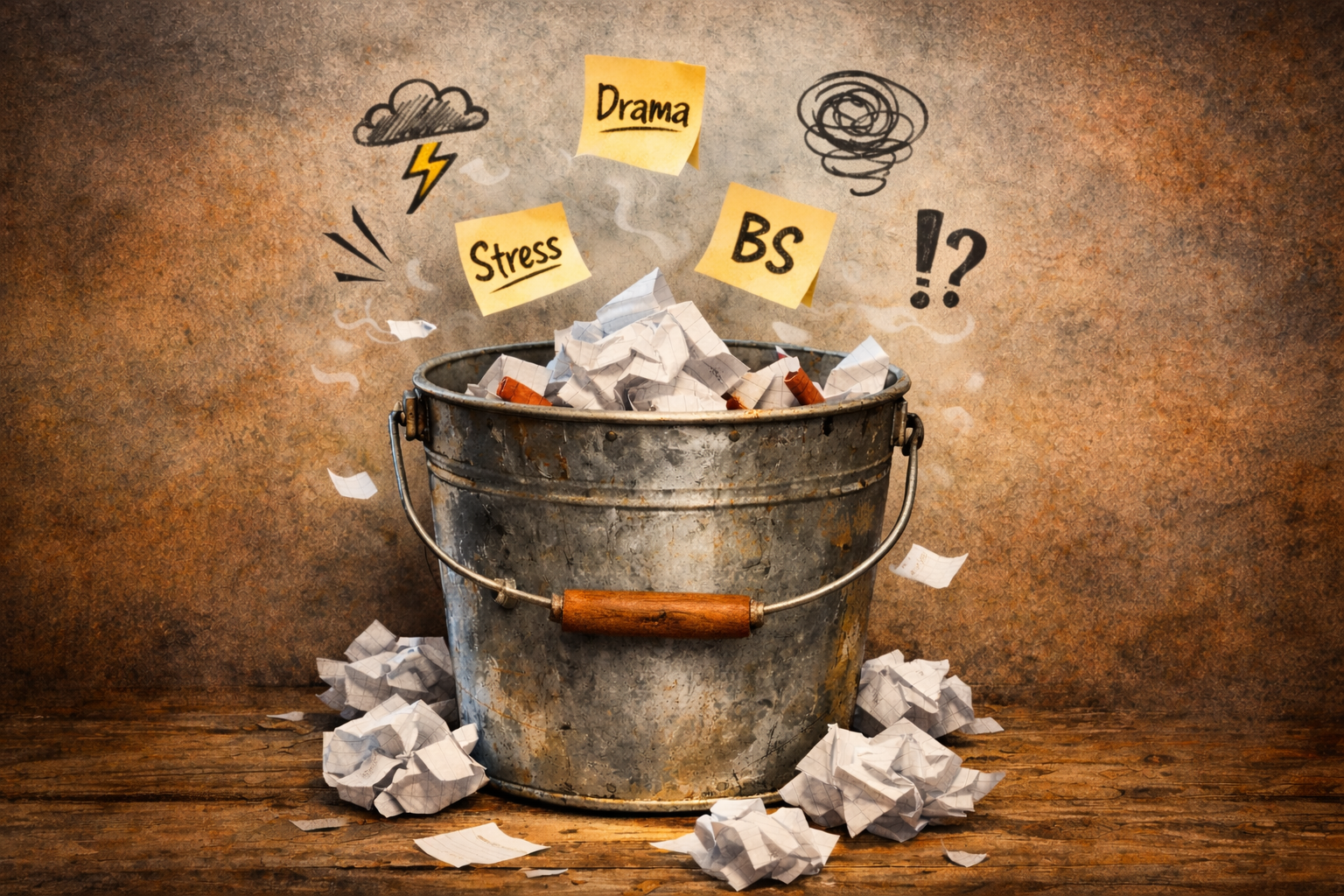
There’s a split second in every stressful moment where you have to decide something.
Is this mine to carry… or am I picking it up out of habit?
For a long time, I picked up everything. Other people’s moods. Misunderstandings. Delays. Traffic. Relationship ambiguity. Work politics. Family dynamics. If it entered my orbit, I assumed it was at least partially my responsibility to manage.
And I would sit with it. Turn it over. Replay it. Try to solve it.
It’s exhausting.
Somewhere along the way, I discovered a phrase that sounds crude but has honestly protected my mental health more than once:
Chuck it in the f*ck it bucket.
Not in a reckless way. Not in a “nothing matters” way. In a clarity way.
When something starts looping in my head, I’ve learned to slow down and ask:
“Is this actually within my control?”
Psychologists call this the locus of control. Some things sit inside our influence. Some don’t. Stress tends to spike when we blur that line and try to manage both. The distinction matters.
You cannot control:
Someone else’s emotional availability
How quickly a company processes paperwork
Whether a storm hits on your hiking day
How someone interprets your intentions
You can control:
How you respond
Whether you communicate clearly
Whether you prepare
Whether you continue engaging
When I really look at it, most of what drains me lives in that first list.
And at that point I have two choices. I can keep chewing on it, hoping it shifts. Or I can put it where it belongs.
There’s a big difference between suppression and discernment.
Avoidance says, “I don’t care.”
The bucket says, “I care, but I’m not giving this unlimited access to my nervous system.”
Cognitive behavioral research consistently shows that rumination, replaying the same unresolved situation, is closely tied to anxiety and depression. When we keep looping on something we cannot change, the brain treats it like an active threat. Stress pathways stay lit up. Cortisol stays elevated. Sleep gets disrupted.
Letting go isn’t passive. It’s protective.
It’s deciding that your energy is too valuable to spend on something that yields no return.
I’ve started thinking about my mind like a battery. I wake up with a finite charge, and throughout the day decisions, conversations, work, and the occasional conflict all pull from it. When I really look at it, what drains me fastest isn’t effort, it’s spending a big chunk of that charge on something I can’t actually influence. Research on stress regulation backs this up. Perceived control is one of the strongest buffers against chronic stress, and when we accept what isn’t ours to control, the body shifts out of fight or flight more easily. The nervous system settles. So the bucket isn’t apathy. It’s not me pretending I don’t care. It’s regulation. It’s choosing where my energy actually goes.
Here’s how I use this in real life:
Step 1: Identify what’s bothering me.
Step 2: Ask, “Can I directly influence the outcome?”
Step 3: If yes, take action.
Step 4: If no, bucket.
I don’t make a big thing out of it. I’m not giving a speech or slamming a door. It’s just a quiet decision in my own head that this isn’t worth carrying anymore. Sometimes that means admitting a dynamic isn’t aligned and letting it breathe instead of trying to fix it. The power in that is quiet. It’s not dramatic. It’s just me choosing not to spiral.
You don’t become indifferent when you start doing this. That was my fear for a long time, that letting go meant I didn’t care. What actually happens is you feel lighter. There’s more space in your head because you’re not constantly running background processes on things you can’t control. I’ve noticed I sleep better. I’m not replaying conversations at 2am trying to solve something that was never fully mine to solve. My focus is sharper. There’s a quiet sense of self respect that comes from knowing I’m not volunteering to carry weight that doesn’t belong to me. And the part that surprised me most is that when I stop gripping the outcome, I’m actually better in the areas where I do have influence. I communicate more clearly. I take action instead of overanalyzing. I save my energy for the things that actually build my life instead of slowly draining it.
Every day there’s going to be something that tries to hook you. A conversation that feels slightly off. A delay you didn’t expect. A response that lands differently than you hoped. It doesn’t have to be dramatic to pull you into a loop. Before you hand it hours of mental real estate, just pause for a second. Ask yourself whether this is actually worth your peace. Ask whether you can truly influence the outcome, or if you’re about to carry something that was never yours in the first place. And if it isn’t yours, you don’t need a big declaration or some symbolic release. You already know.
That’s when you quietly decide to let it go and chuck it in the f*ck it bucket.